

EN

A small connector. A tight enclosure. And a lesson in what engineering collaboration really means.
Several years ago, RHT Sales Engineer Rick became involved in the development of a European AC Energy Meter.
It was a compact product with a demanding objective: reliable energy monitoring, long service life, a small enclosure and stable performance in everyday operation.
For the engineering team, every detail mattered.
PCB dimensions.
Enclosure clearance.
Component selection.
Electrical performance.
Mechanical fit.
Reliability.
Manufacturability.
And, eventually, the ability to produce the same product consistently at scale.
These are the details that are often invisible when a finished product is sitting on a shelf.
But behind every reliable product are engineers, purchasing managers and supply-chain professionals who have spent countless hours studying specifications, comparing options, solving problems and making decisions.
Rick has always respected that work.
Through years of working with engineering teams around the world, he has seen how much care and responsibility goes into turning an idea into a product.
Different countries may have different working cultures and different ways of communicating.
But good engineering has a common language:
Understand the problem. Challenge the details. Find a practical solution. Make it reliable.
For this Energy Meter, a Terminal Block was mounted on a small PCB.
At first, the component selection seemed straightforward.
But once the prototype was assembled inside the enclosure, the engineering team discovered a problem.
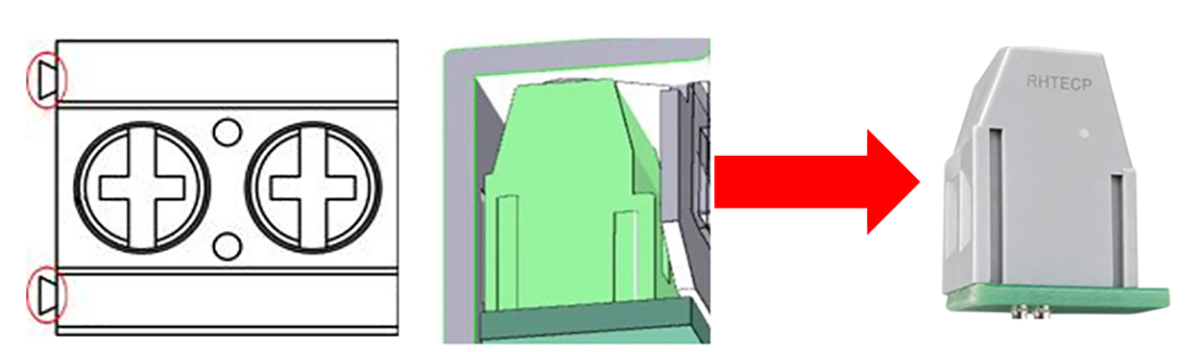
There was simply not enough room for the rails on one side of the Terminal Block.
For the samples, Rick carefully removed the unnecessary section by hand, creating the clearance needed for the prototype.
The prototype worked.
But Rick knew that the prototype was only the beginning.
The next question was more important:
How do we make this solution work reliably in mass production?
A manual modification may be perfectly reasonable for a few prototypes.
It is a different matter when thousands of products need to be manufactured consistently.
If the Terminal Block had to be completely redesigned, with new plastic moulds and redesigned metal structures, a small clearance problem could quickly become a much larger development and cost issue.
It could also create unnecessary supply-chain risk.
Rick therefore proposed a dedicated tooling solution for the required modification.
Instead of changing the entire component, the unnecessary section could be removed through a controlled and repeatable process.
It was a relatively small engineering solution.
But it helped connect the prototype stage with the requirements of mass production.
The goal was not simply to solve today's sample. It was to prevent tomorrow's production problem.
As development continued, another issue appeared.
The height of the Terminal Block became critical to the mechanical clearance of the Energy Meter.
The existing tooling could not fully satisfy the required dimensions.
A conventional approach would have been to redesign the Terminal Block and develop completely new tooling.
Rick looked at the problem differently.
Instead of asking only:
“How can we change the connector?”
he asked:
“Can we optimize another part of the system and achieve the same result?”
One option was to optimize the PCB thickness to create the required clearance.

This approach considered the complete product rather than treating the Terminal Block as an isolated component.
It was another example of a small engineering decision potentially avoiding a much larger change.
This is where Rick believes the role of a supplier becomes meaningful.
A component supplier can provide a part.
A solution provider looks further.
From component selection to prototype assembly, from tooling decisions to pilot production, and from the first production run to long-term supply, every stage can introduce a different risk.
The R&D engineer is focused on performance and design.
The mechanical engineer is focused on fit and structure.
The purchasing manager is balancing cost, availability and commercial feasibility.
The supply-chain team is thinking about lead time, consistency and continuity.
Manufacturing is thinking about process capability and repeatability.
A successful solution has to respect all of these perspectives.
Rick's role has often been to connect them.
With experience across different electronic industries and manufacturing environments, he works to understand not only what a component needs to do, but also how it will be developed, produced, purchased and supplied over the long term.
That means asking questions early.
Can this part be supplied consistently?
Can the design be manufactured economically?
What happens when the quantity increases?
Will the tooling support long-term production?
Is there a simpler way to solve the mechanical constraint?
The earlier these questions are considered, the fewer surprises appear later.
The Energy Meter eventually moved through the familiar journey:
Concept → Component Selection → Prototype → Pilot Production → Mass Production
There were challenges along the way.
There were design discussions, tooling decisions, cost considerations and supply-chain questions.
And there were many people involved.
For Rick, that is what makes engineering collaboration so meaningful.
The finished product may carry a brand name, but behind it are many people who contributed to its success — engineers who refined the design, purchasing managers who balanced technical and commercial requirements, supply-chain teams who protected continuity, and manufacturing teams who turned drawings and specifications into repeatable production.
Rick is proud to have worked alongside these teams across different countries and cultures.
Not because every project was easy.
Quite the opposite.
It is the difficult details that make collaboration valuable.
For RHT, this is the direction we continue to believe in.
Not simply supplying a connector.
Not simply responding to a drawing.
But participating early enough to understand the engineering objective, identify potential risks and provide practical options.
From selection to prototype, from tooling to pilot production, and from mass production to long-term supply, the purpose is the same:
to help engineers make better-informed decisions and help projects move forward with greater confidence.
This is what being a Design Partner means to Rick.
It means respecting the expertise of engineers.
Understanding the commercial responsibility of purchasing.
Recognizing the importance of supply-chain stability.
Understanding different cultures and ways of working.
And bringing product knowledge, manufacturing experience and practical communication together when it matters.
After years of development, when a product finally moves from an idea to a working prototype and then into reliable mass production, there is a shared sense of achievement.
For everyone involved, the connector may have been only a small part of the product.
But sometimes, solving that small part is exactly what helps the whole product move forward.
That is the value of engineering collaboration.
That is the role RHT wants to play — from component selection to mass production, as a reliable Design Partner.
